

The United Nations keeps a detailed record of the injustices of the world. They document wars, occupations, sanctions, and atrocities. Often in careful detail. What it cannot do is act on almost any of it. Five governments each hold a veto in the Security Council, and nothing binding happens without all five agreeing. That is the catch. The institution records the world's crimes, but it cannot stop the ones committed by its five most powerful members, or by anyone those five choose to protect.
The UN was built in 1945. What it fails to do follows from how it was built. I took the public tour to see what the building says about itself.
After booking online and paying $30 (a pretty good deal, I might say), you fill out a form with your information and upload a passport photo. The day of, you arrive an hour early, show your reservation and ID. They print a badge and you clip it on. You wait in line a while for the airport-like security. It's fascinating though, because the people-watching is good. I spotted a bunch of uniformed foreign military men waiting in line too, and had fun trying to guess where they were from by the flag patch on the shoulder (I noted Jordanian and Guyanese).
It is actually a myth that you are leaving the United States without crossing a border. The UN owns the land but isn't sovereign over it. It's still US territory; the 1947 agreement only keeps US authorities from entering without the UN's consent. It's a similar kind of protection a foreign embassy gets, and an embassy isn't foreign soil either, though people think it is. Julian Assange spent seven years inside the Ecuadorian embassy in London for exactly this reason: British police couldn't enter without permission, but the ground always belonged to Britain. The day Ecuador withdrew its consent, they walked in and carried him out.
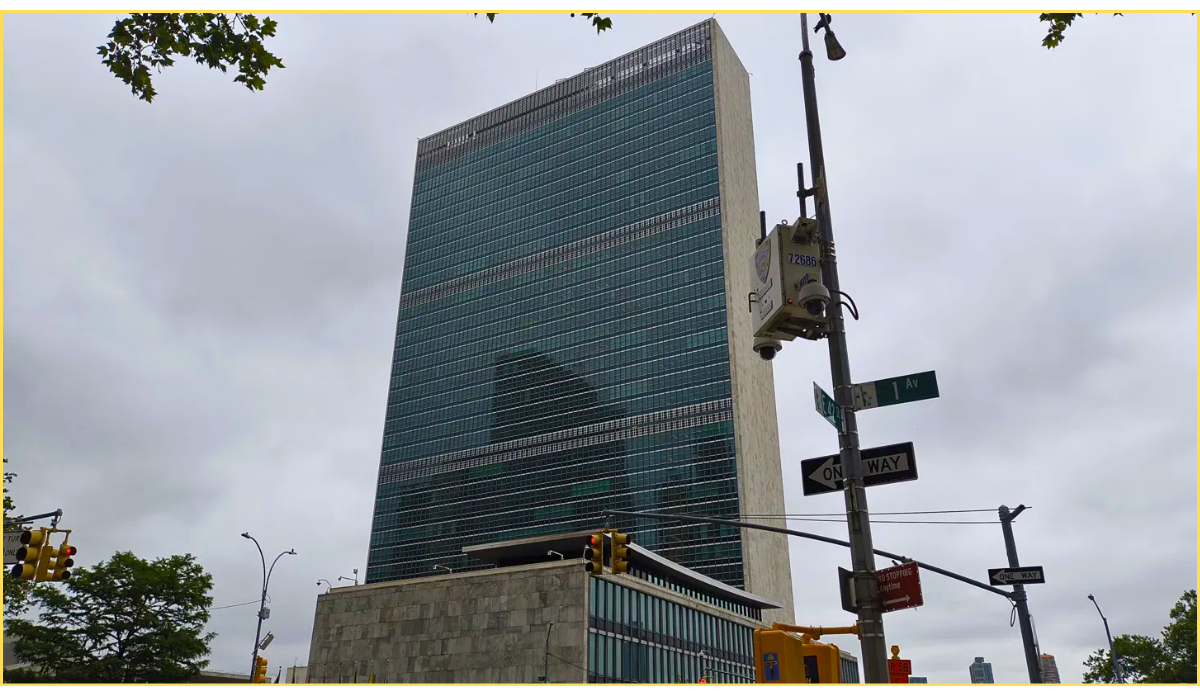
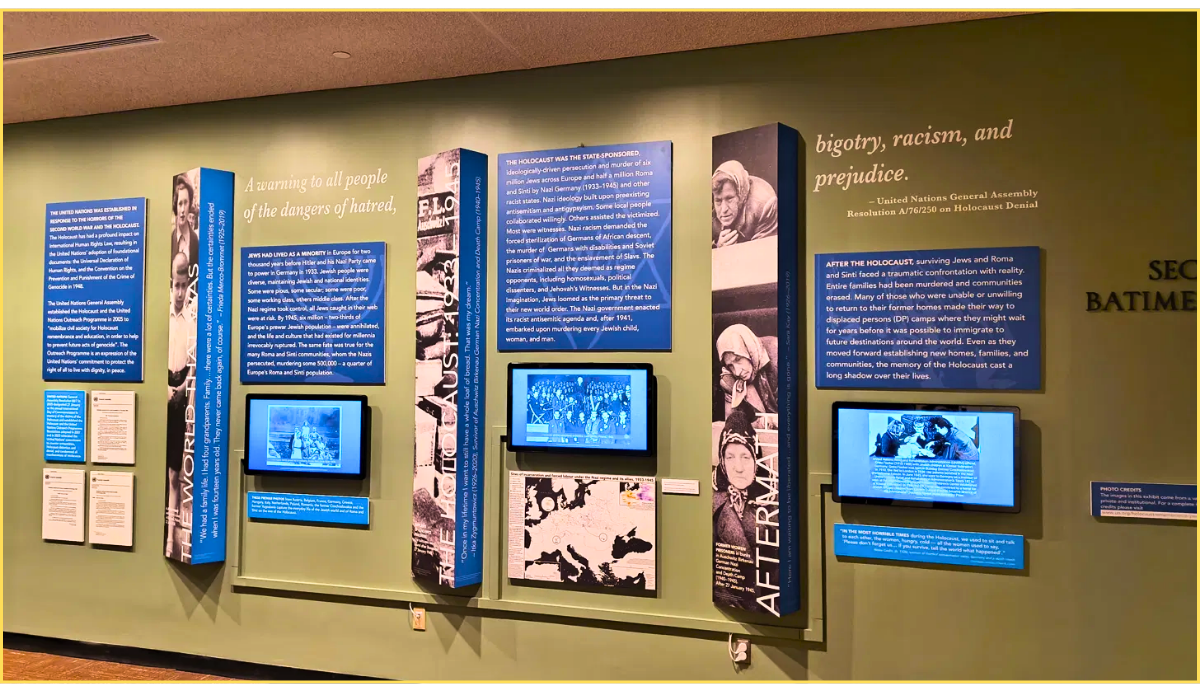
The first thing the tour wants you to understand is why the institution exists. The guide tells you it was created in response to the Second World War and the Holocaust. The panel on the wall calls it a warning to all people of the dangers of hatred, bigotry, racism, and prejudice. This is the founding promise. Standing there, I sort of believed it. The guide was earnest, the building has a certain weight to it, and it feels like you are inside a place where real work is being done to hold the world together.
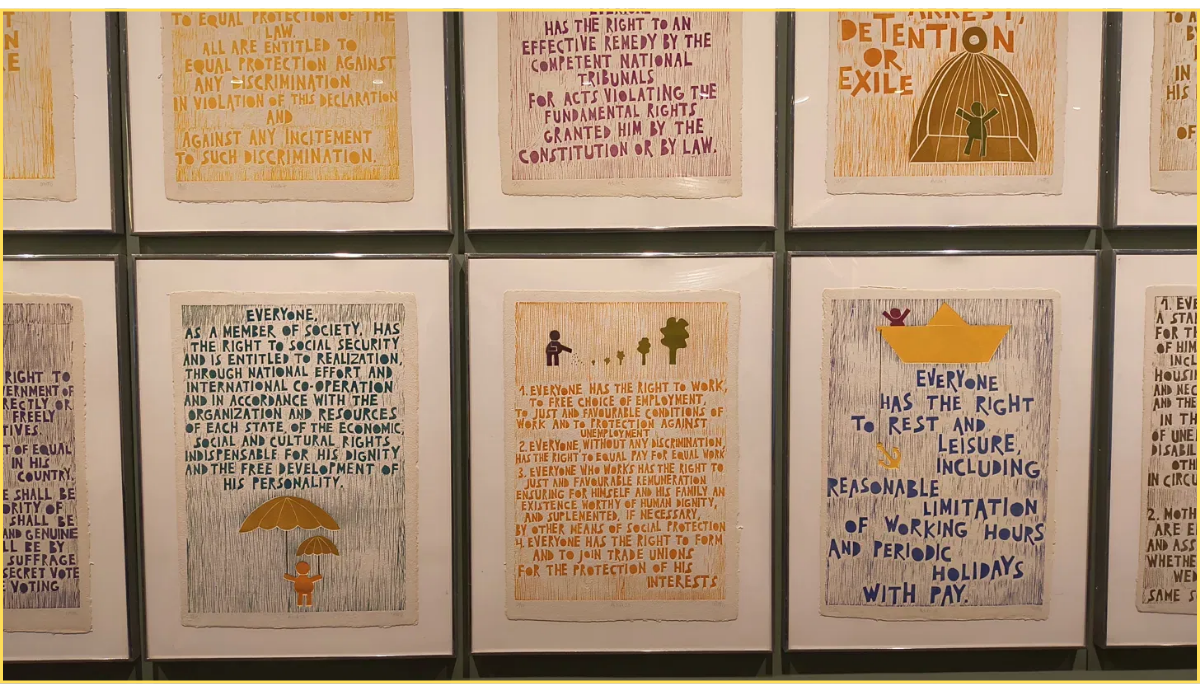
The Universal Declaration of Human Rights hangs, article by article, as an art piece. It is the UN's founding statement of rights, adopted by the General Assembly in 1948: the right to work, to rest, to protection from arbitrary arrest. The artwork is by Otávio Roth, a Brazilian artist who illustrated all thirty articles on his own initiative and showed them at a New York gallery in 1980. A staffer in the Secretary-General's office saw the show, liked it, and invited him in. They have hung at UN headquarters since 1981. The most-displayed image of the Declaration in the building is there because one official walked into a gallery.
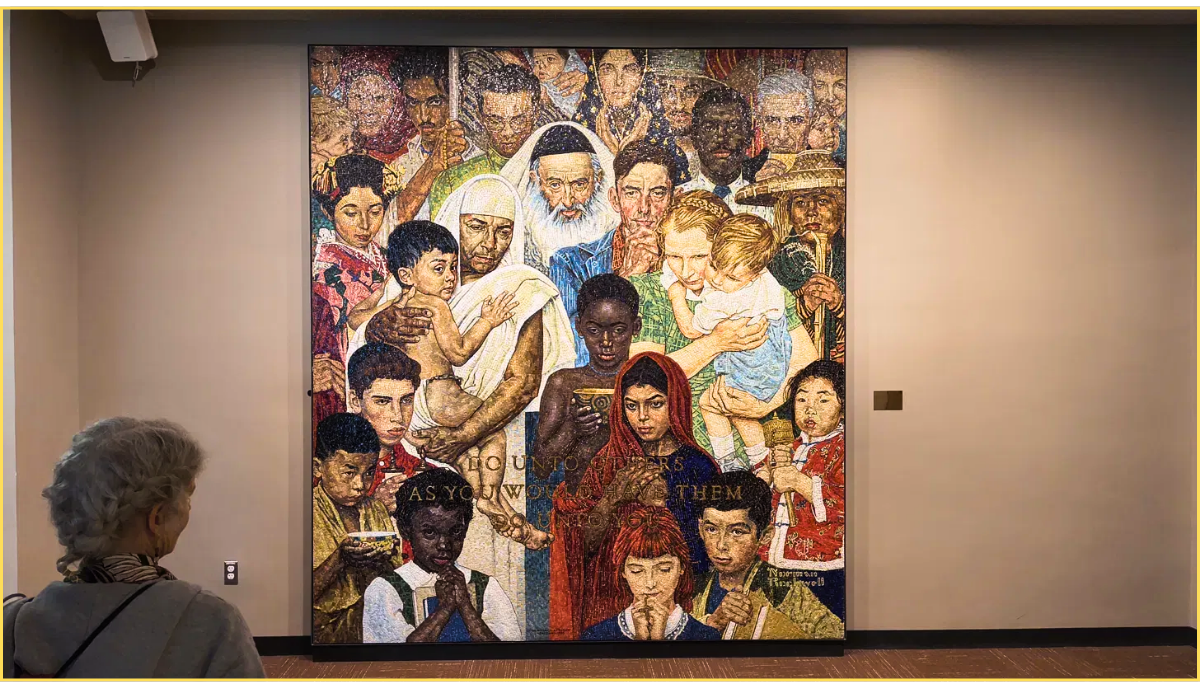
On another wall is a Norman Rockwell mosaic, a crowd of the world’s faces meant to stand for all of humanity. At the center is a white-bearded elder in white robes, a Jewish rabbi. Across the middle runs the sentence: do unto others as you would have them do unto you. It is from the Sermon on the Mount. So an image meant to hold all of mankind is built around a Judaic elder and a Christian gospel verse. The golden rule appears in almost every tradition on earth, but here it is given in its Judeo-Christian form and placed at the center, as the source. One civilization’s moral vocabulary is offered as the baseline for everyone, and everyone else is arranged as its audience.
The mosaic did not arrive by accident. It is a gift of the United States, unveiled by Nancy Reagan in 1985. It would be moving if the government that gave it were not, in the same years, for example, mining the harbors of Nicaragua. In 1986 the UN’s own court ruled that mining illegal and ordered the United States to stop and pay reparations. The United States had already walked out of the proceedings. When Nicaragua took the ruling to the Security Council for enforcement, the United States vetoed it. The mosaic says do unto others. The same government was told by the World Court to stop what it was doing, refused, and used its permanent seat to kill the resolution that would have made it comply. Imagine it the other way around with a stronger country mining American harbors, ignoring the court, vetoing the enforcement. Nicaragua is one example among many. The tour mentions none of it. The mosaic is a gift, and you are meant to admire it as one.
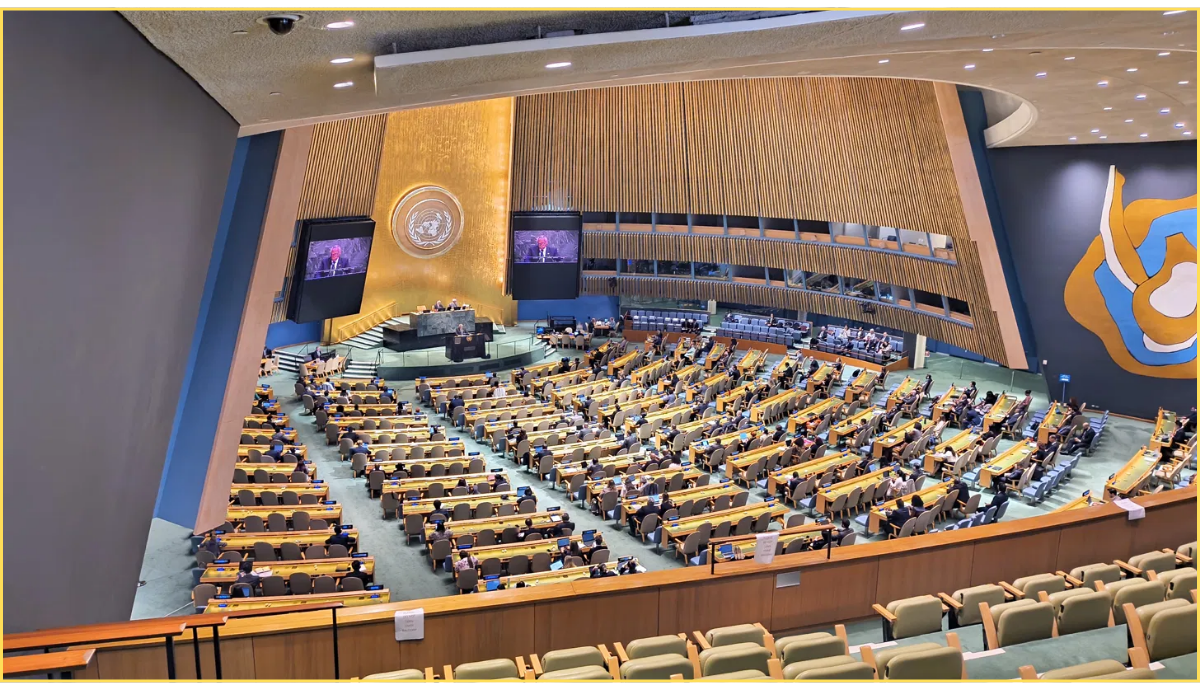
The General Assembly was in session the day I went. It was the last room on the tour, and I am starting with it when it comes to the rooms. Every recognized state has a seat and a vote here, all 193 of them, and the room was maybe half full. A delegate was speaking. I could not tell which country he was from. I asked the guide; he did not know either, and said you can usually tell from the lapel pin, but we were too high up and too far back to make it out. We guessed Angola. I wanted to know who he was and what he was saying, but there was no way to find out from the balcony, and no way for the guide to stop and get into it, if he even could.
The General Assembly decides almost nothing that binds anyone. General Assembly resolutions are recommendations. The votes with force behind them happen somewhere else, in a smaller room, decided by fewer people. The Assembly is the part of the building where the whole world speaks. That is a separate thing from where the world acts. The tour saves it for last for because it is the furthest room out, near the elevators where you exit. But it is also the biggest and most democratic-looking room in the building and there is something fitting in being walked through it on the way out. It is like they are setting you up to make sure you leave with a good impression.
Take the embargo on Cuba. For thirty-three years running, the General Assembly has voted to condemn it. In the October 2025 vote, the vote was 165 to 7. It has never once actually mattered. The resolution is non-binding, and the only body that can lift the embargo is the United States Congress. So the whole world, assembled in the room built to represent it, demands the same thing for three decades, and the country doing it does not have to listen.
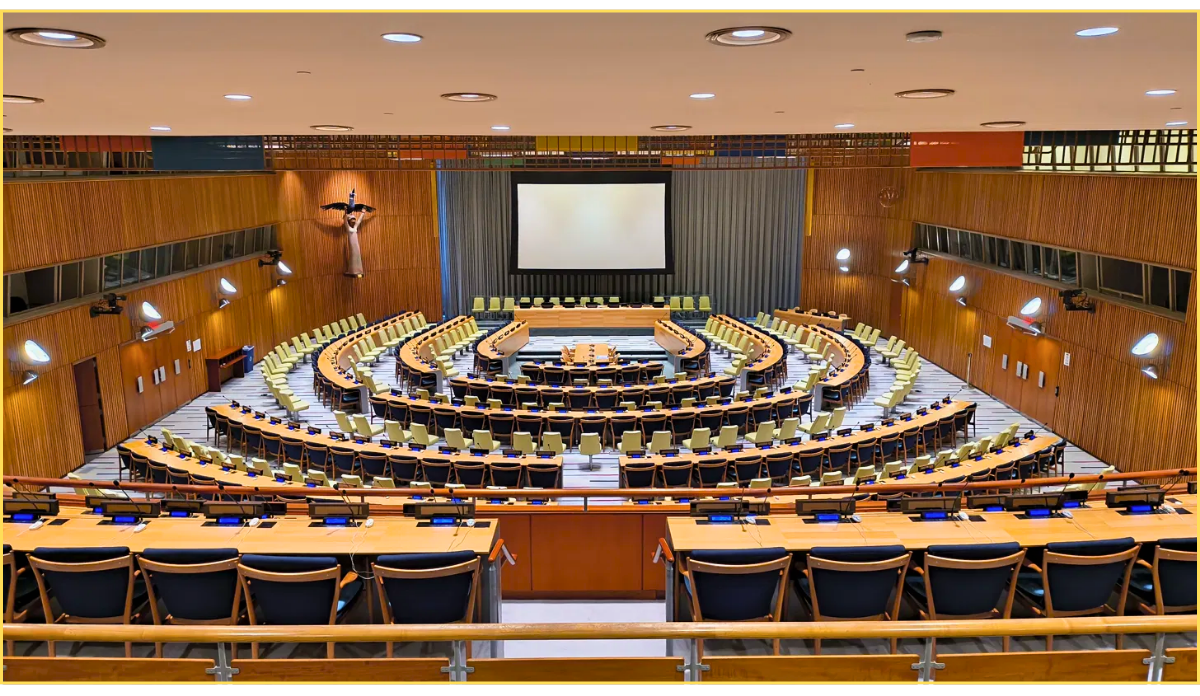
There is a chamber that no longer meets. The trusteeship council oversaw the end of formal empire. They walked colonial territories to independence until the “last one”, Palau, became independent in 1994. Then it declared its work done and suspended itself. The room is kept intact for some reason.
But the file it closed isn’t really closed. What ended was the foreign flag and the foreign governor. The control didn’t end. It just moved outside. Now it's whoever sets the terms from outside the country: what a country can charge for what it sells, what it has to pay for what it buys, which leaders get money and which get pushed out, which coups get a quiet nod, which rebels get weapons, which elections get bought, rigged or suspended. Most of the Global South still trades on terms it didn’t set, and is still kept weak enough that it keeps needing the same countries that keep it weak.
It’s not just the old European empires anymore. Other powerful states that weren’t really colonizers, and big banks and companies that don't really answer to anyone, are all part of it now (or more intensely involved now). The trusteeship council shut down the moment this kind of control stopped being official, and the UN has acted like the problem was solved ever since.
What replaced it has no room. It isn't one office or one council. It's spread across the whole building, and a lot of it happens outside the UN entirely. That's what makes it hard to see. The old trusteeship council was one room you could point at. What came after has no address at all. Shutting the council down let the UN say colonialism was over while the same control just kept going somewhere else.
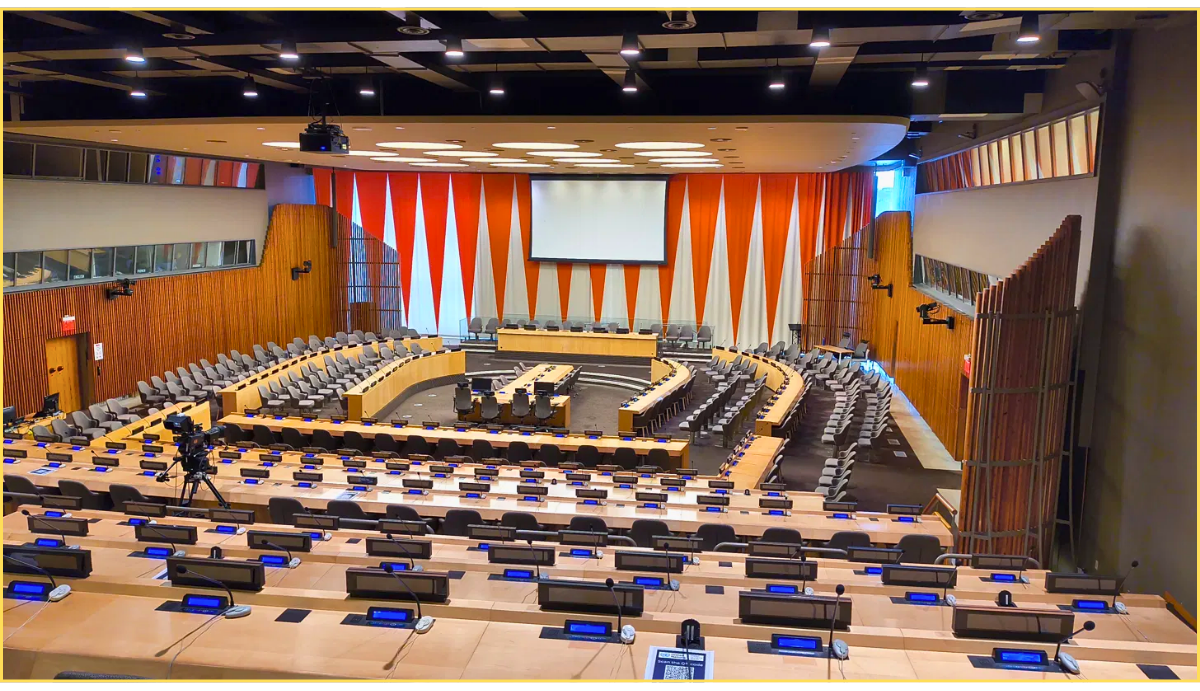
Then we got the Economic and Social Council. This is the organ meant to handle development, trade, poverty, the economic relationship between rich countries and poor ones. It is, in theory, the room where the world addresses inequality between nations. It also has no binding power. It issues reports and recommendations and cannot make a single government act on them. The decisions that actually determine whether a poor country can develop, the terms of its debt, the price of what it sells, the conditions attached to what it borrows, are made in the IMF, the World Bank, and the WTO, where votes are weighted by wealth and the rich countries hold the majority by design. The UN’s economic chamber only discusses the problem. The institutions that hold the power over it are somewhere else, and they are not one-country-one-vote.
The room is a gift of Sweden. As you can probably tell now, all three council chambers are Scandinavian furnished. First in the 1950s, arranged by the first Secretary-General, who was Norwegian: Norway did the Security Council, Sweden this one, Denmark the Trusteeship. When the chambers were renovated in 2013, each country was handed back its own room to redo. So the rooms have permanent owners the same way the Security Council has permanent members. It is a small, largely insignificant detail next to what does and doesn’t happen inside them, but it is an interesting fact.
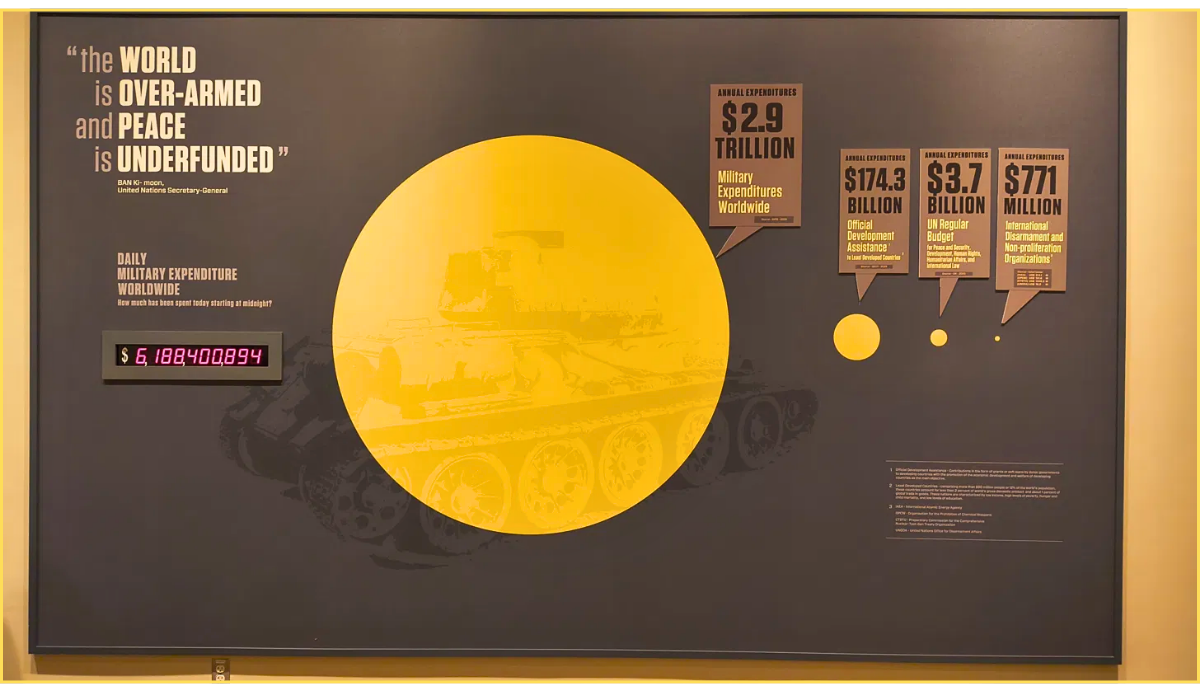
On the way to the General Assembly, the tour walks you past a board the UN made about arms. It quotes a former Secretary-General: “the world is over-armed and peace is underfunded”. Below the quote are the figures. Worldwide military spending, $2.9 trillion a year. The budget for the world’s disarmament and non-proliferation bodies, $771 million. A running clock counts the day’s military spending in real time.
The board says “the world” is over-armed, which spreads the blame evenly. But The United States outspends every other country by a wide margin, more than its nearest rivals put together, and it is still climbing. Congress authorized roughly $900 billion for the Pentagon in 2026, and once the extra military funding passed alongside it is counted, the year crosses a trillion dollars. The administration has requested $1.5 trillion for 2027.
And it isn’t only the United States. Everyone is arming. Europe is rebuilding militaries it had let shrink, Japan is tearing up limits it kept for eighty years, and states that can barely afford it are doing the same. Some do it out of ambition and some because they have calculated they have no choice, but the direction is the same everywhere: up. The board is right that the money is obscene. It just leaves out who spends the most of it, and who sets the pace the rest are matching.
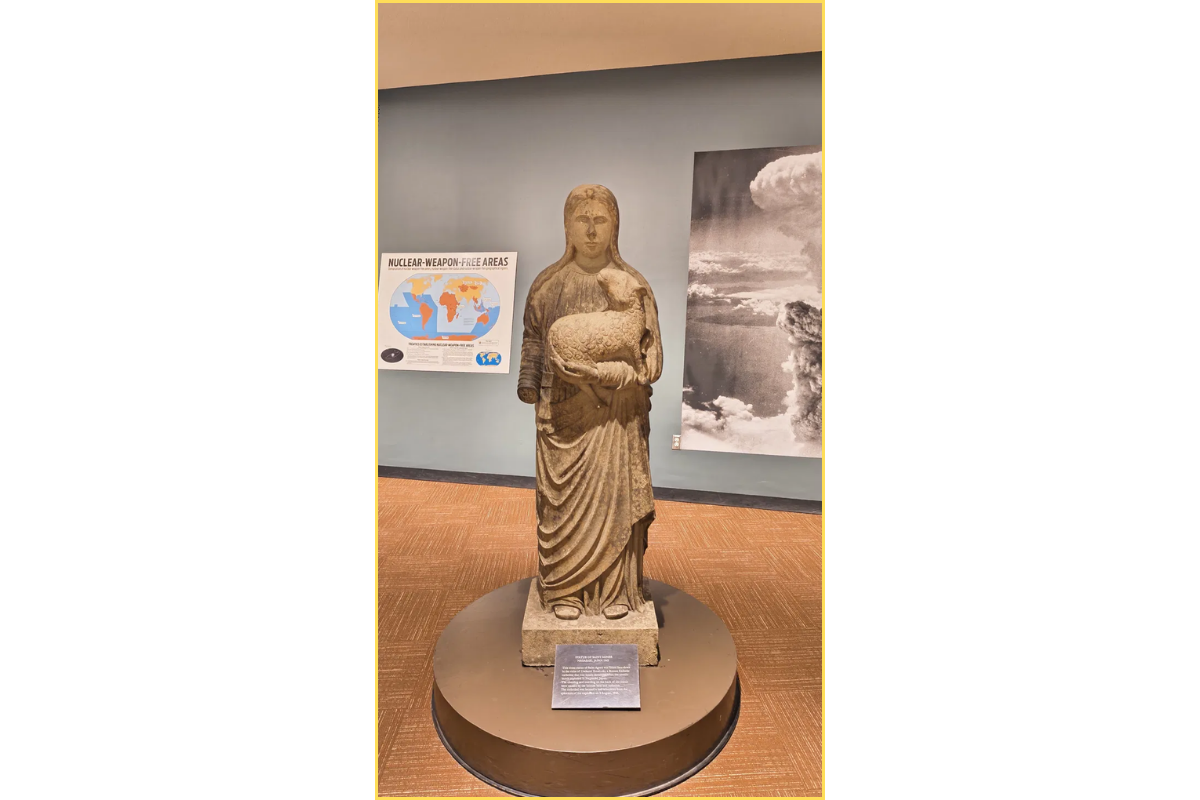
Nearby stands a stone Saint Agnes pulled from the ruins of a cathedral near the Nagasaki hypocenter. The cathedral it used to belong too was called Urakami Tenshudo, in the Urakami district, the oldest and largest Catholic community in Japan. They descended from converts who held their faith through centuries of persecution. The bomb detonated 500 meters away. The back of the statue is scorched.
Beside it is a map of the world's nuclear-weapon-free zones. There are nine nuclear-armed states, but only five are recognized by the treaty as nuclear-weapon states and those five are the permanent members of the Security Council. The Non-Proliferation Treaty logic is that the five who already had the bomb in 1968 may keep it, and everyone else agrees never to build one.
None of the five will give up theirs. Each calls its own arsenal defensive, a matter of survival, while treating the same weapon in anyone else's hands as a threat. The message is that some states are entitled to defend themselves this way and others are not. And the states without the bomb are the ones that get invaded, sanctioned, bombed, and pressured, while the ones that have it are handled carefully. Give up the bomb and you are exposed. Keep it and you are safe. Libya ended its weapons program in a 2003 deal with Washington and London, and its leader was dead in a NATO-backed war eight years later. North Korea kept its program and has not been touched. Anyone watching learned the same thing: the surest protection against invasion is the weapon the treaty exists to deny you.
India and Pakistan both built their bombs outside the treaty. Both were sanctioned briefly and then normalized. India was even handed a US nuclear deal that treated its arsenal as a fact to work around rather than a violation to punish. Israel did the same, built its arsenal outside the treaty, never signed, never admitted it, and has never been made to account for it. Stay out of the treaty and build the weapon, and the system adjusts to you. Iran did the opposite. It signed, it let inspectors in, and it was bombed over a weapon there was no proof it had built. The state that stayed inside the rules and opened its doors is the one that got hit. The strikes on Iran also makes proliferation more likely, not less. Inside Iran, after the strikes and the killing of its supreme leader, the argument that gained ground was that the country should have built the bomb years ago, that the mistake was restraint. And the pressure spreads outward: Saudi Arabia and Turkey have both said or signaled they would get their own if Iran did. The lesson of hitting an inspected signatory is that inspection and restraint are what get you attacked. The rule was never that nuclear weapons are dangerous. The rule is that some states may have them and others may not.
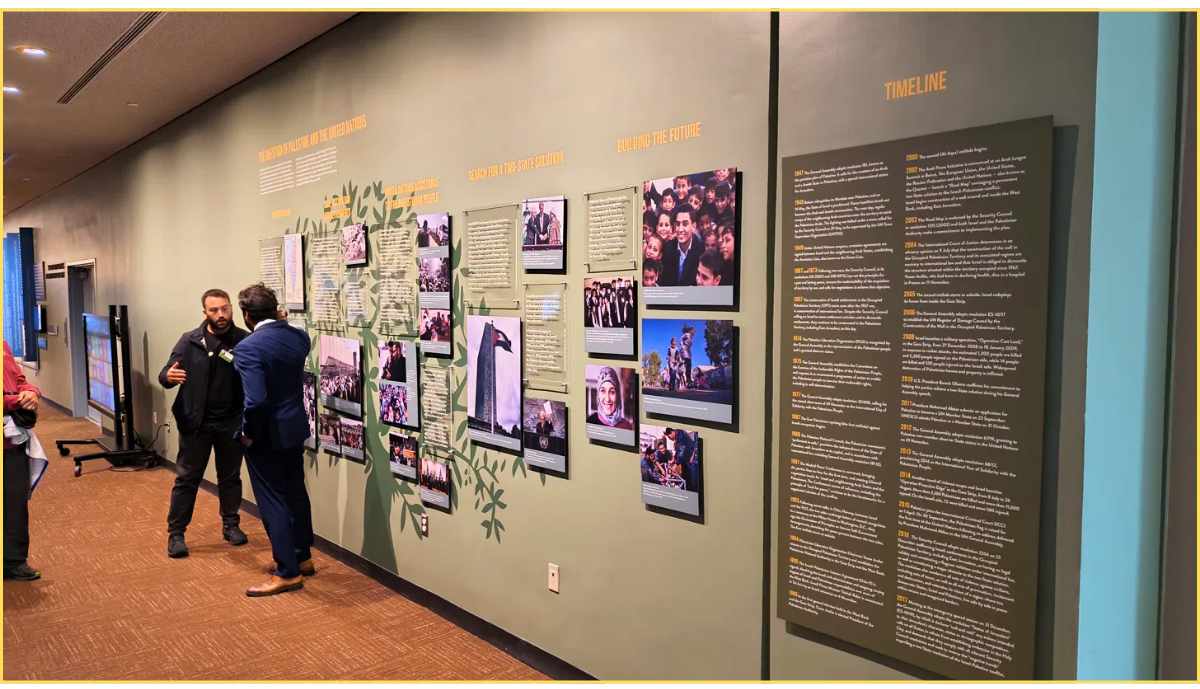
There was a wall exhibit on Palestine. It runs year by year and it starts with the 1947 partition. The 1967 occupation. The settlements, which the UN records as contrary to international law. The resolutions. The operations in Gaza, with the dead counted on the panel in the UN’s own figures.
The timeline ends in 2017. Everything after it is missing. The 2023–present Gaza war is absent. So is South Africa's genocide case before the International Court of Justice. So are the findings of multiple UN bodies and investigators that emerged after October 2023. The institution's own wall goes silent eight years before the most consequential period in the conflict's modern history. Whether that reflects bureaucratic inertia, political caution, or the difficulty of updating a display on an issue this contested, the result is visitors leave with a chronology that stops before the events that now dominate the debate.
A visitor stopped the tour here. He was Israeli, and he wanted the group to understand that the wall was wrong. The guide waited. Nobody in the group said anything. I looked around, a few people rolled their eyes, most just stared ahead, waiting for it to end. No one argued. No one agreed. The man made his case to a group that had already decided not to engage, and the tour moved on. It was the only stop where anyone interrupted. Nobody stopped the tour at the Trusteeship chamber, or the disarmament board. You are a tourist on a public tour; you are there to look, and the guide is not a policy expert who could argue the fine points even if you wanted to. There is nothing to win. And still, at this one wall, an Israeli man felt he had to stop everything and make his case to a bunch of strangers. (He also invited the Uzbek guide to Israel so he could see the “truth” for himself 😂)
The placement says something too. We walked past the Palestine wall at the very beginning, on the way to start at the Holocaust exhibit, and came back to it after the three council chambers and before the General Assembly. You could read that path as an answer prepared in advance. Of every issue the UN handles, this is probably the one a visitor is most likely to raise, and the building has a careful and sympathetic wall ready for it, held until near the end of the tour.
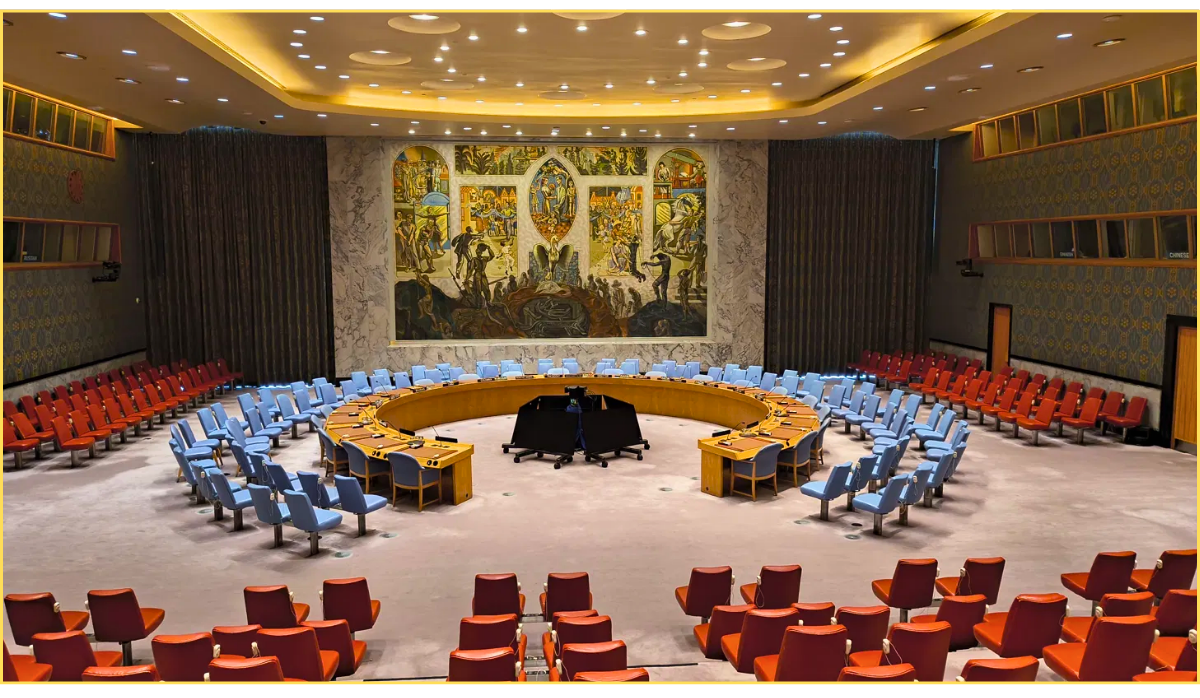
The Security Council was the first room on the tour. I have kept it for last. It is a small room for what it is. It is the only room in the building where the decisions bind. Above the table is a mural by Per Krohg, a gift of Norway from 1952, a phoenix rising from the ashes of war. It is a nice image to hang over the table, and it has nothing to do with what the table does. The phoenix says rebirth, peace, the world starting over. The seats beneath it were an arrangement to keep the five winners of one war permanently in charge, each with a veto so that none of them could ever be overruled. They do not agree with each other. Most of the time they block each other. Its not five states ruling together, but five states that each kept the power to stop anything, so that nothing the world decides can ever be forced on any of them. Eighty years on, it still works exactly like that. The mural is the part you photograph. The table is the part that works.
The five permanent members are China, France, Russia, the United Kingdom, the United States.The other ten rotate, and decide nothing on their own. Take the seats on their own terms. The case for the veto is that you seat real power, because a rule the strong ignore is worse than no rule at all. But the five were chosen for the world of 1945, not this one. Some of them were empires then and are middle powers now (The UK), holding a permanent veto over the entire planet on the strength of a war that ended eighty years ago. Meanwhile the states with the most people, the largest of the emerging economies, whole regions of the world, were not in the room in 1945 and have not been let in since. India has more people than any country on earth, the fourth-largest economy, nuclear weapons, and one of the biggest militaries in the world, and no permanent seat. Neither does any nation in Latin America, nor any of the fifty-four states of Africa. The arrangement the council enforces is out of date. The obvious fix is to change who sits at the table.
It will not happen. Amending the UN charter requires the agreement of all five permanent members, and each of them holds a veto over its own removal. Any seat that no longer fits the world could only be given up voluntarily, by the state sitting in it, and no state gives up a veto over the entire planet. So the most obvious reform in the world is also an impossible one. The council is not a body that refuses to change. It is one that cannot, because it was built that way on purpose.
There is also a smaller room nearby where the fifteen members meet in private, among themselves, with no cameras and no record. This is where the actual arguing and dealing happens. No press is allowed in. No outside states can sit in. By the time a resolution reaches the public chamber I was standing in, it has already been settled in there. It is the least democratic room in the building, which is probably why it isn't on the tour. The ten elected members, the ones meant to represent everyone outside the five, sit in, but the bargaining that decides things runs through the permanent five. Lately the ten have started pushing back, banding together to force votes the five would rather avoid. In June of last year they tried to break the deadlock on Gaza. The United States vetoed it. That is the ceiling on what the elected members can do: they can force the vote, and the vote is where they lose.
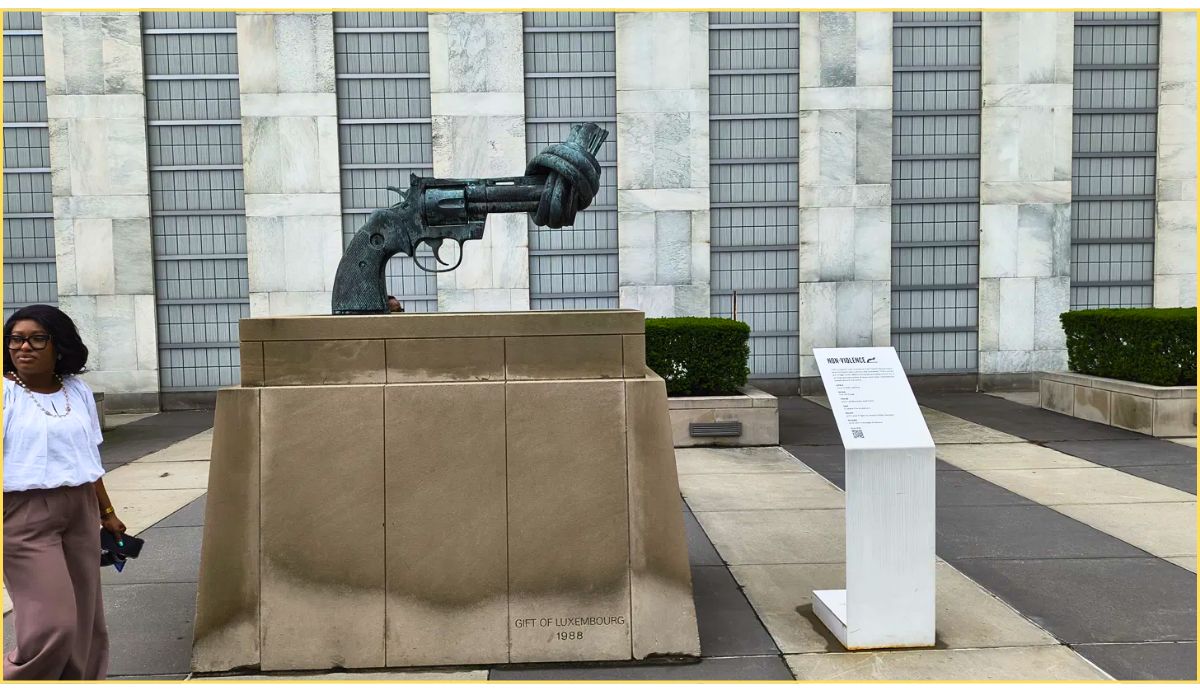
Outside the visitors' entrance there is a bronze revolver with its barrel tied in a knot, a gift of Luxembourg from 1988. I had walked past it on the way in without stopping. I looked at it on the way out. The knot is a nice idea. However, ever since the UN was founded in 1945, at the dawn of the nuclear age, and in the eighty years since, weapons have advanced faster than in all of human history before it. We went from the first atomic bombs to hydrogen bombs thousands of times stronger, from artillery to precision missiles and armed drones flown from another continent. The institution built to end war has presided over the fastest arms race the world has ever seen. Ironic.