

In 2021, I spent about a month road-tripping around Albania with friends. It is a small country, so in that time we saw most of the major cities and large stretches of the countryside. It remains one of the more fascinating places I have traveled, partly because they got bunkers everywhere.
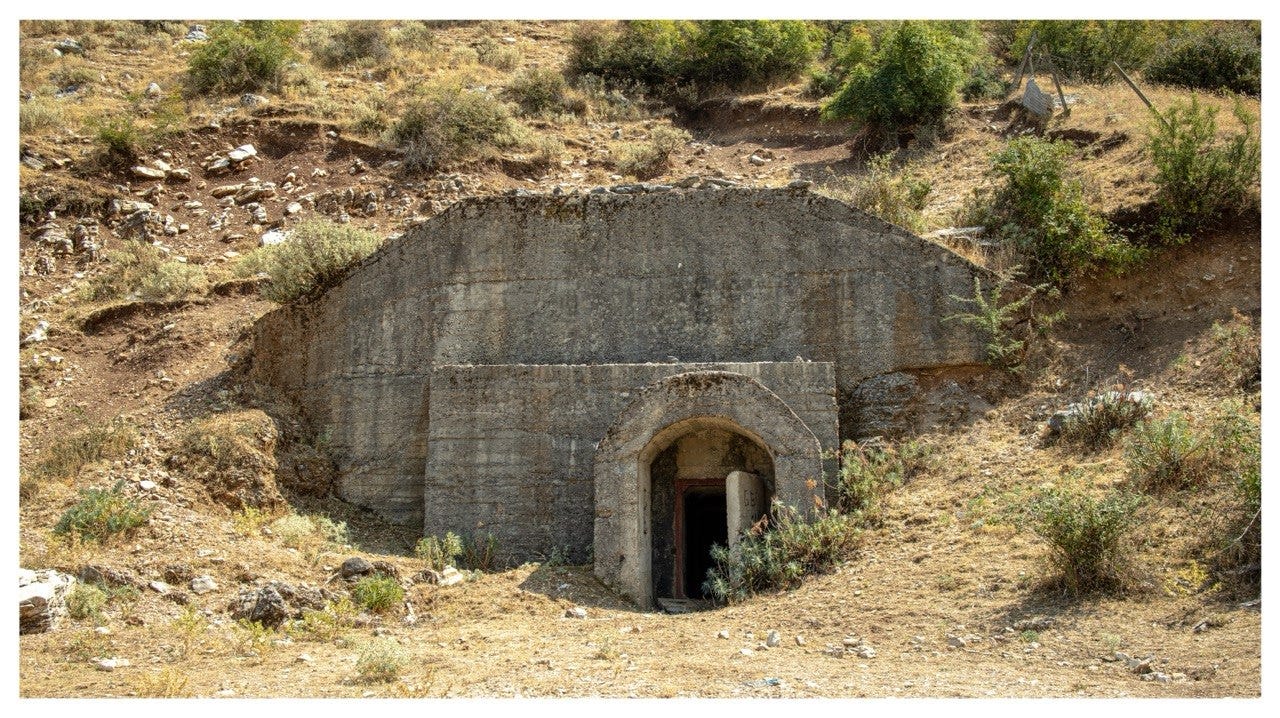
You drive through or along cities, mountains, villages, coastlines, random empty fields, and there they are. Concrete reminders of a regime that once feared the outside world so deeply it physically fortified itself against it.
The best way to explain the vibe in Albania is calm. Outside Tirana there were mostly older people, quiet towns, half-empty villages, unfinished buildings, decent roads, and long stretches where the country felt caught somewhere between post-communist transition and whatever comes next.
Tirana at night felt like a different country entirely. Once the sun went down, parts of the city turned into a parade of wealth. The streets around the downtown restaurants, bars and clubs filled with traffic. Except it was not ordinary traffic. It was luxury cars everywhere. Ferraris, BMWs, G-Wagons, Lamborghinis. Men in black suits driving slowly through the city like a moving display case of power and money. Which was strange, because Albania is one of the poorest countries in Europe. The countryside I had just driven through felt closer to the developing world than to the EU. So where were the Ferraris coming from? You do not have to spend long in Albania before the same answer keeps surfacing.
Albania has long carried a reputation, fair or unfair, for organized crime. That reputation has shaped both the country’s international image and parts of its post-communist economy for decades.
There was also a lot of unfinished buildings scattered throughout the country. Outside the center of Tirana, you constantly pass half-built seemingly abandoned structures. Empty developments standing in strange places with no obvious purpose. I noticed it far more than almost anywhere else I have traveled.
Albanian is also an incredibly hard language to pick up as a foreigner. After a month there, I learned nothing beyond Thank you (Faleminderit), and one word I kept seeing everywhere: “Shitet,” meaning something like “for sale.” It was written across buildings, apartments, storefronts, empty lots, everywhere.
The explanations I heard for all the strange construction varied. Some said speculation, corruption, money laundering, construction bubbles, permits frozen midway through projects. Whatever the cause, the effect on the landscape is unmistakable. And yet, despite all of it, Albania really is beautiful.
The mountains in the north, the coastline, the towns, the Ottoman history, the Mediterranean vibes, the cafes, the Italian influence, the roads through the south. It genuinely does feel like a hidden gem. Albania’s fascinating history was probably the main reason why I wanted to go there, but I cannot lie, the travel vlogs definitely had some influence too. When travelers and YouTubers began marketing it online as Europe’s underrated destination, I understood why. Next to Croatia or Greece, it still feels less consumed and less polished.


Which is one of the main reasons why global capital is arriving now. Places like Albania only stay “hidden gems” temporarily. Eventually the algorithms find them. Then the investors arrive. Then the luxury developments. Then the branding campaigns. Then the prices rise. Then the country slowly reorganizes itself around tourism, real estate, and foreign demand. That is the stage Albania appears to be entering now.
When I was there, Tirana did not really feel like a major capital. It felt like a medium sized city, with one upscale center. Not really the luxury towers now associated with PM Rama’s new Tirana. The transformation has been fast. Albania is being rebranded right now in real time. A capital that only a few years ago still felt almost like a provincial capital is now being pushed into the language of luxury towers, foreign architecture, investor summits, and real estate speculation.
Nothing captures that speed and what’s happening in Albania in general more sharply than what is now planned for a small island off the southern coast. It may soon become a luxury resort backed by a man who sits at the center of American political power, Gulf sovereign wealth money, and the post Abraham Accords economic order.
The island is Sazan, it sits on the Strait of Otranto, right where the Adriatic and Ionian seas meet. A strategic chokepoint which passed through Roman, Byzantine, Venetian, and centuries of Ottoman control before being heavily fortified by Mussolini’s Italy during the Second World War. Under communist Albania, the island was transformed into one of the regime’s most secret military bases, covered with roughly 3,600 bunkers, underground command infrastructure, ammunition depots, bomb shelters, Soviet-installed naval infrastructure and roughly ten miles of fortified tunnels connecting military positions carved through the rock.
Now, decades later, the same island is being recommissioned as a luxury destination for globally mobile elites. Or so they say.


that transformation is not accidental.
The public story of how Trump’s son in law and daughter, Jared Kushner and Ivanka Trump first became interested in Sazan almost sounds like travel content.
According to Ivanka, they were on a friend’s yacht in the Mediterranean, stopped for a swim, “found” the island, swam ashore, hiked around barefoot, and became fascinated by the place. Coming from her, it sounded like a story about discovery, beauty, architecture, conservation, and long-term vision. It’s hard to imagine the “barefoot hike” was quite as spontaneous as it sounds or even possible, considering the island is filled with bunkers, tunnels, snakes, undetonated mines and abandoned military infrastructure.
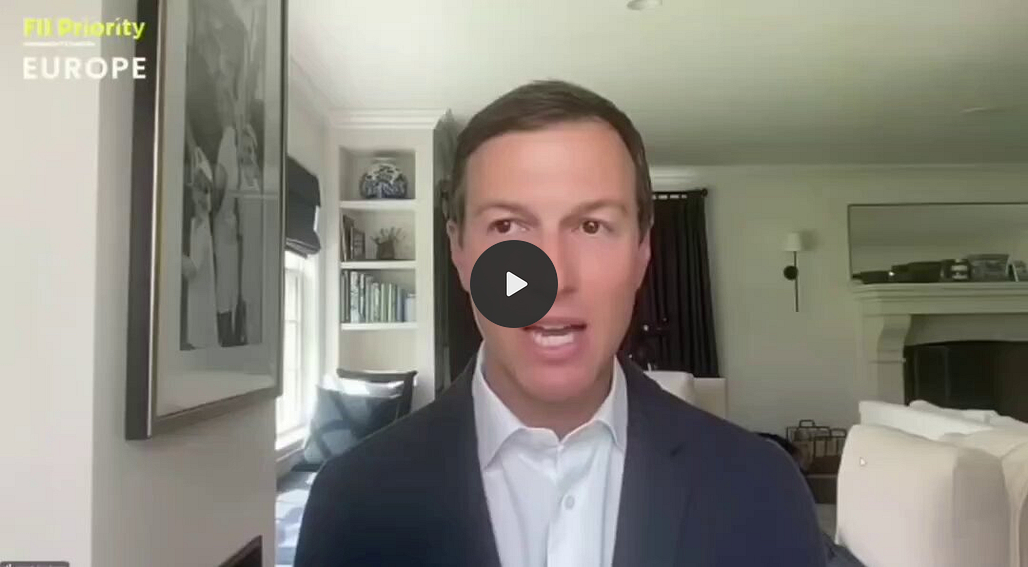
Kushner mentioned at the FII PRIORITY summit in Tirana, speaking by video call, that the yacht belonged to Nat Rothschild, which honestly tells you everything you need to know about the world this project is emerging from.
Kushner also mentioned that he first met Prime Minister Edi Rama aboard that same yacht in the summer of 2021 and came away impressed by Rama’s vision for transforming Albania. He explained that about a year later, while actively searching for investment opportunities in the Balkans, he remembered the trip, looked more seriously at Albania, and became especially interested after learning that a major international airport was already being developed near Vlorë. This interview took place last May, a full year before Ivanka came out telling the barefoot-discovery version. Someone should have told her that her husband had already given away the real timeline.
So now, the question is not whether Kushner and Ivanka liked the island. Albania is beautiful. Lots of people would. The question is how a swim and a supposed barefoot hike or some chance encounter at sea on a yacht with a Prime Minister of a nation, became a billion-dollar strategic investment on protected coastal land, with government backing, in one of the most sensitive environmental zones in the country. Vacations do not usually end in reclassified national parkland.
who is jared kushner?
The project is tied to Jared Kushner, founder and managing partner of Affinity Partners, former White House senior adviser, and current United States Special Envoy for Peace Missions. Few individuals sit at the intersection of American political power, Gulf money, Israeli leadership, diplomacy, and global real estate the way Kushner does.
During Donald Trump’s first administration, Kushner helped oversee the Abraham Accords and the relocation of the U.S. embassy to Jerusalem. In Trump’s second administration, he has returned as one of the president’s most trusted diplomatic advisers, participating in negotiations involving Gaza, Ukraine, Iran, and broader Middle East peace efforts while simultaneously leading an investment firm backed by billions from Saudi, Qatari and Emirati sovereign wealth funds. This combination of political influence, diplomatic access, and financial capital is what makes the Albania project more than a simple real-estate deal.
The project represents the arrival of a specific type of globally connected capital into Albania, capital that moves through political relationships, sovereign wealth funds, elite investment networks, and personal connections stretching across Washington, Tel Aviv, London, Riyadh, Dubai, Doha and beyond.
The same post-Abraham Accords political world that promised prosperity through normalization and investment is now expressing itself physically and extending far beyond the Middle East itself.
Albania has maintained relations with Israel for decades, so this is not some sudden geopolitical realignment. But the country can still be used as an example of what happens when a Muslim-majority nation with good relations with Israel becomes attractive to this network of capital. Kushner arrives, and suddenly “development” follows.
A side note on religion:
Albania is often described as a Muslim-majority country, but that can be misleading if read through the politics of the Middle East. Albanian identity is unusually secular and national. The country has large Muslim, Orthodox, Catholic, and non-religious communities, and religion usually matters far less politically than Albanian national identity.
Even Albania’s modern leaders show that complexity. Enver Hoxha came from a Muslim family background but built one of the most aggressively atheist states in the world. Edi Rama comes from an Orthodox Christian background but governs in a country where religious identity rarely defines politics in the way outsiders might expect.
To be precise about the footprint, this is really two separate developments. There is the roughly $1.6 billion “Sazan Island Touristic Resort,” granted strategic investor status by Albania’s Strategic Investment Committee on December 30, 2024. Sazan is currently uninhabited. Parts of the island remain under military control and it receives occasional tourists and guided visits.
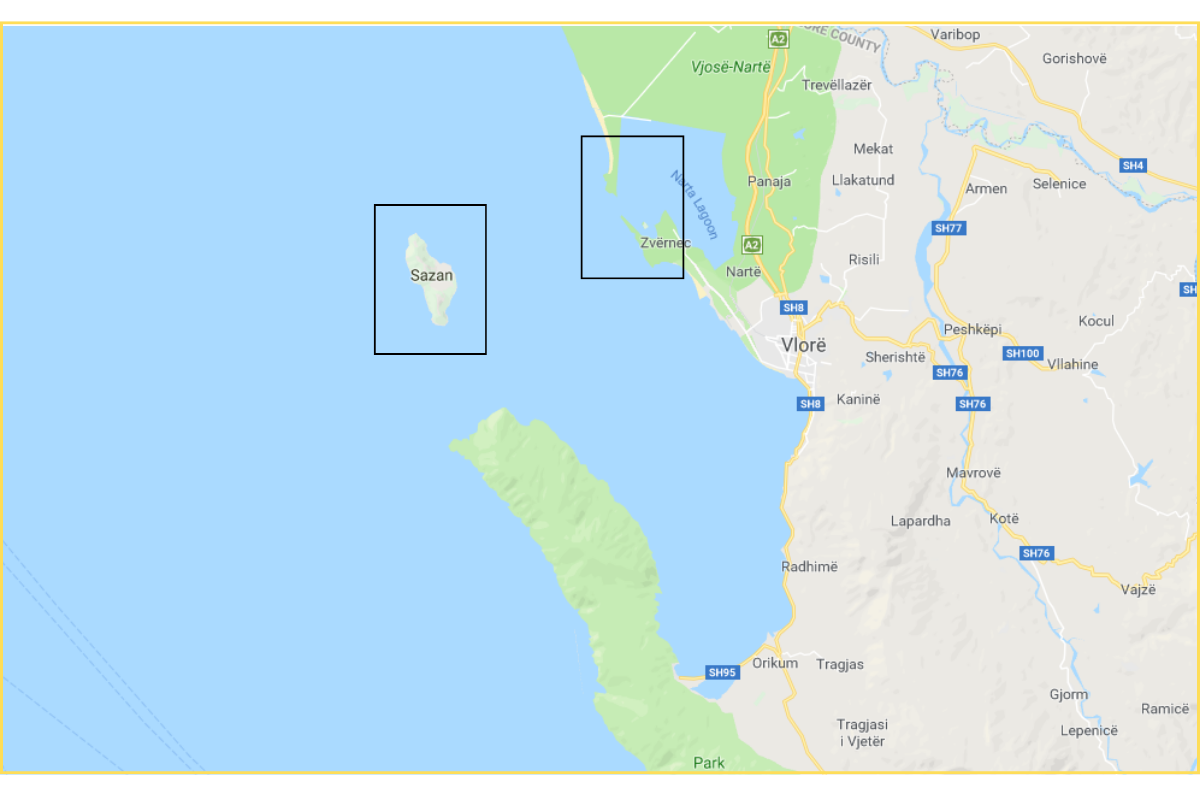
Then there is the much larger mainland $4.7billion component near Zvërnec and the Vjosa-Narta protected landscape, north of the city of Vlorë. Unlike Sazan, this is not an empty island. The broader area includes villages, local residents, fishing communities, agricultural land, and growing tourism activity. It is also one of Albania’s most ecologically sensitive coastal regions, home to flamingos, pelicans, sea turtles, and hundreds of migratory bird species. This land was legally protected until the government decided it shouldn't be. In 2024, Albania amended its law on protected areas and redrew the boundaries, quietly lifting protection from the exact stretches now slated for development
The island is the headline because the symbolism is impossible to miss. A rich, politically connected American investor, with deep ties to Israel, trying to develop a private luxury resort on a bunker island. At a time when the world is still processing the scandals tied to a certain wealthy and connected man and his private island. But the coastline is where the real transformation is happening.
who is edi rama?
Rama presents himself as a modernizer. Before becoming prime minister in 2013, he was a painter and a professional basketball player, then mayor of Tirana, where he made his name ordering the city’s drab communist apartment blocks repainted in bright colors. He has always understood politics visually through image, surface, the look of a thing and as prime minister he scaled that instinct up from paint to concrete. He speaks the language of Davos and the investment-forum circuit. It’s always innovation, integration, growth. That seems to be what attracted Kushner to him. At the FII summit, Kushner said he was struck by Rama’s background as an artist and found it interesting to imagine what a country could look like when led and built by an artist, someone like Rama.

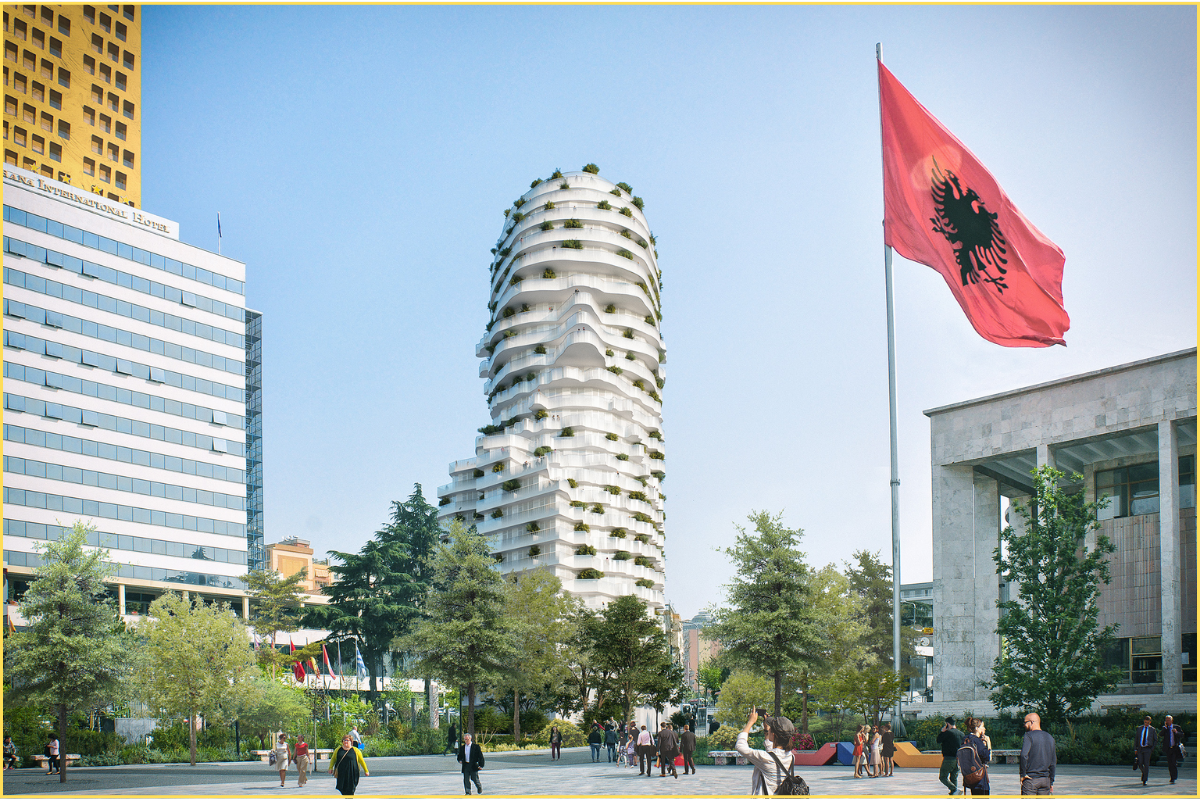
Tirana is the showcase. The low-rise communist city he started with is now studded with towers, many designed by international star architects he handpicks himself and gathers for festivals, almost like a curated collection rather than a market responding to need. A luxury-apartment market that barely existed a few years ago now sells units before they are built, largely to Albanians living abroad, at prices that have roughly tripled and even people inside the industry call it a bubble. Developers pitch the city as the next Monaco. The Albanian Riviera, meanwhile, is marketed online as Europe’s last hidden paradise.
To supporters, this is modernization and to many Albanians, understandably, the alternative to Rama feels worse. Young people were leaving anyway. If tourism, foreign capital, and luxury development can raise incomes and pull Albania closer to Western Europe, many are willing to accept the tradeoff. But modernization for who?
Because there is a difference between building a sovereign economy and packaging a country for consumption. A sovereign economy develops productive power like industry, engineering, technology, energy, scientific capacity, manufacturing, food security, and pathways for citizens to build wealth themselves. A packaged economy sells experiences. It sells coastline. It sells cheap labor. It sells tourism. It sells “hidden gem” branding. It sells residency permits, passports and apartments to foreigners. It sells luxury access to outsiders. It sells the country itself as a platform. And eventually, the population becomes economically dependent on serving people wealthier than themselves.
Roughly 2.2 million Albanian citizens, nearly half of all Albanians, already live abroad, one of the highest emigration ratios on earth. Rama frames developments like this as a way to draw them home, to give the diaspora a reason to return and invest. Maybe. But the only time Albanians have come back in large numbers was during the 2008 crisis, when Greece and Italy cratered and going home briefly made more sense than staying. It was a return driven by the West's collapse, not Albania's success. The flow since has reversed back the other way.
A luxury resort priced for foreigners is not the thing that will reverse the reversal. Neither are the luxury apartments. The diaspora can buy them, and many do, as investments, but owning a flat in Tirana is not the same as moving back to it. The reason they left was that Albania could not offer the wages or the careers the West could. A holiday apartment does not change that. You can hold the keys to a place on the new skyline and still have to fly back to Germany to actually earn a living, because the economy underneath the towers still has no room for you. So the apartment becomes one more asset bought with money made abroad, which is just another problem, not a solution to anything.
there isn't much underneath the tourism.
Albania's economy is thin under the tourism. The sector now makes up roughly a quarter of it, and what holds up the rest is not the kind of thing that builds a country. There is no major industrial engine capable of carrying the economy. The economy leans on remittances sent home from abroad, alongside construction, some farming, mining, and low-wage service work, garment assembly stitched for Italian fashion brands, call centers answering phones for companies in Milan and Rome. It is an economy that mostly serves other people’s economies.
None of this is an argument against tourism, or against foreign investment. Tourism is not the problem. Depending on it is. In a healthy economy, tourism is a complement, it sits on top of something that actually produces and adds to it, rather than holding the whole thing up. And this has nothing to do with size. Slovenia is smaller than Albania and gets plenty of tourists, but it also kept its industry and makes pharmaceuticals and machinery. Estonia is tiny and built a technology economy from almost nothing. For both, the visitors are a bonus, not the foundation. Small countries can absolutely diversify. They just have to choose to.
Albania is leaning the other way. The sensible move from here would be to diversify, to build the productive base the country never really had, so tourism becomes one income stream among several instead of the whole bet. The Kushner model does the opposite. It doubles down on the one thing Albania already over-relies on, and spends the country's most valuable asset, its coastline, to make that dependence permanent.
And in a country leaning this hard on outside money and visitors, foreign approval starts to matter more than it should. The government chases rankings, investor conferences, travel lists, influencers, international branding. The country starts seeing itself through the eyes of outsiders, and at some point even the leadership begins behaving like a marketing department.
When the streamer IShowSpeed visited Albania, he met with Rama himself. No disrespect to Speed, he is massively influential online, but it is worth asking why the leader of a country is spending time meeting internet entertainers in the first place. The answer is that visibility has become economic strategy. Attention itself becomes infrastructure, virality is political because global perception directly affects investment, travel, and foreign money flows. The country begins competing not only for capital, but for online relevance.
albania has experienced massive emigration for decades.
In 2025 alone, the country recorded a net migration loss of roughly 28,500 people, meaning more Albanians left permanently or for extended periods than returned or settled in the country. The population has now fallen to around 2.33 million.
The outflow disproportionately affects younger generations and includes educated professionals seeking opportunities elsewhere. The average age of the country is now 45. Huge numbers of young Albanians continue leaving for Germany, Italy, the UK, and elsewhere in Europe. Many skilled workers simply do not believe they can build stable futures at home. The answer Rama offers to all of it is the same single word: Europe.
EU accession is the great project of his politics and he pursues it with something closer to devotion than strategy. “We are fanatics. We are not like the others. We are the fanatics of the EU faith,” he told Euronews. For Albania, he added, there is “no Plan B, there is no alternative, there’s nothing.”
There is no alternative, because Rama won't allow one to exist. Everything he chases is about how Albania looks from the outside. None of it touches what is actually driving people out: an economy with no real base and no careers that pay.
Rama approaches politics the way an artist approaches a canvas. The image comes first. The skyline. The branding. The spectacle. The way the country appears from a drone shot, an architecture render, an investment summit, a travel vlog. Meanwhile the country underneath the picture he is painting keeps emptying out.
protests began last month in the coastal villages slated for development,
Heavy machinery and barbed-wire fencing arrived at the site, and within weeks the anger had spread to the capital. Thousands gathered in Tirana, many outside Rama’s office, holding inflatable flamingoes, a reference to the threatened lagoon, and signs reading “CANCEL THE PROJECT,” “ALBANIA IS NOT FOR SALE,” and “I DON’T WANT ALBANIA LIKE DUBAI.”
A lot of foreigners, especially Americans, assume the backlash is about Trump and Kushner. It isn’t. Albania is one of the most pro-American countries in the world. Many Albanians see the United States as an ally, tied to NATO, to Kosovo, to the support that came after communism and during the Yugoslav wars. Anti-Americanism has never been a real force in Albanian politics.
What Albania does have is a long memory of being looted by its own political class. In the 1990s, pyramid schemes swallowed people’s savings and pushed the country into near-collapse. Since then, corruption, organized crime, patronage, rigged privatizations, and shady construction have been permanent features of public life.
So when Albanians see protected land reclassified, public access fenced off, politically connected investors welcomed, and billions promised through back channels, they recognize the pattern. A country that has been cheated before is being told, once again, to trust the people managing the deal. The anger is not that the buyers are American. It is that the state appears willing to reshape parts of the country around powerful outside capital first and ask the public to trust the process afterward.
And the model it is reshaping the country around has a name. Dubai runs on imported labor: a small, oil-rich citizenry that owns and is served, while the cooking, cleaning, building, and driving are done by millions of foreign workers kept on cheap, temporary, near-rightless terms. It is an ugly arrangement, but it holds together for one reason. Oil made the citizens rich enough to sit on top of it. Emiratis do not wait the tables. The lower-status labor is outsourced to people from somewhere else.
Albania is copying that arrangement without the part that makes people tolerate it. Be honest: most people, if given the choice, would probably take the Emirati deal. Set the ethics aside and the citizen sits at the top of an extraordinarily wealthy system. Oil wealth, subsidies, state benefits, high incomes, almost no taxes. The entire structure is designed so the Emirati citizen profits from the machine even if migrant labor carries much of it on its back.
But what exactly is Rama’s version offering Albanians? Even if everything works exactly as promised, Albania does not become Dubai. It becomes a poorer country reorganized around serving wealthier outsiders. The coastline fills with villas, resorts, marinas, and investment properties priced for rich foreigners, while the actual work falls either to Albanians themselves or to imported labor from even poorer countries.
Facing a labor shortage created by its own emigration, Albania has begun importing workers from the Philippines, India, Nepal, Bangladesh and Egypt to fill its hotels and resorts.
This is how it works for a developing country stuck in the middle of the ladder. The rich countries at the top only receive; the poorest at the bottom only send. Everyone in between does both at once, exporting its people upward and importing cheaper hands from below to replace them. Albanians leave for Germany to do the work Germans have moved up from, and Filipinos and Bangladeshis arrive to do the work Albanians have left behind. Albania has settled comfortably into its rung instead of trying to move up it, and selling the coast to foreign capital is how you stay there for good.
Rama’s whole approach looks like a bet. Build a Dubai of Europe, a coastline glittering with Gulf money and Trump-branded resorts, and the spectacle speaks for itself. Make the result dazzling enough and Brussels has to let him in, the rezoning and the fast-tracking forgiven as the price of a success story. And if a deal of this magnitude goes through, the precedent is set: everything is for sale on these terms, as long as it can be called “investment.”
Don’t clean up how the deals get done, just make them shine so bright nobody looks too closely. The flaw in the plan was the partner. Rama has always loved a spectacle, and for years it worked. But this time he chose to make one with the most watched, most scrutinized family on earth, and a spectacle built around the Trumps is not one anybody looks away from.
rama has not responded like a leader trying to calm a country down.
He has responded like a man defending an investment pitch.
He has refused to halt the process, framing the project as a historic opportunity to push Albania into a higher class of Mediterranean tourism. In one interview, he argued that Albania is facing a “hybrid war,” claiming that bots, fake profiles, hostile outside forces, and anti-development actors are exploiting environmental concerns and Albania’s relationship with Israel to attack the project.
Notice what Rama reached for. Defending a project that critics attack on environmental, land, and corruption grounds, he volunteered a denial of something the Albanian protesters were not even saying, that this is a secret deal with Bibi Netanyahu to resettle Palestinians on the Albanian coast. He called the idea a “total fantasy.” Maybe it is. But nobody marching with inflatable flamingoes was asking about Palestinians.
That is a tell. When the people in the street are worried about a lagoon and a no-bid land reclassification, and the prime minister answers by swatting down something unrelated, he is showing you which connection he is most anxious about.
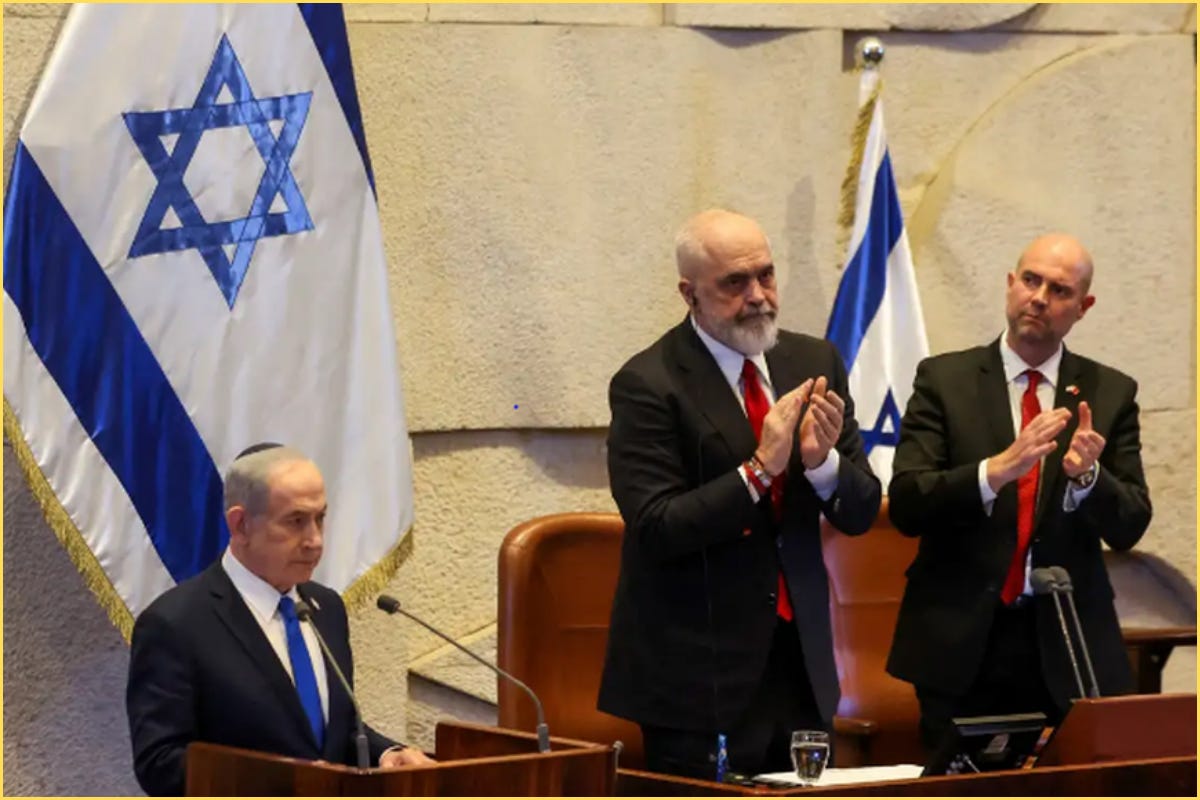
who is the new albania being built for?
Rama also insists there is no final project to cancel yet. "There is no project yet," he says, only "a vision and a plan." The final proposal, he told parliament, has not even been submitted, and the environmental study is not finished. According to him, the development is still being worked on by major international architecture studios and will eventually be presented publicly. He has described the goal as creating an exclusive and environmentally responsible destination, not simply pouring concrete over the coast.
But that is suspicious. If there is no final project, why has the political commitment already sounded so absolute? What exactly was he discussing with Jared Kushner on Nat Rothschild's yacht five years ago? And why does the playbook already look familiar? Because the same government built Vlorë airport by starting construction inside the protected Vjosa-Narta landscape in 2021 and then redrawing the boundary to cut the site out of the protected zone afterward. Conservationists who visited the coast in early May reported excavators already digging up the beach and trucks laying gravel. There is no project, Rama says, only the heavy machinery is already on the sand.
Defending the development, Rama said it was vital that Albania not receive “the stigma of being a country where investors are met with hostility,” adding that “there is absolutely no chance that the investment will stop as long as I am here.” That sentence reveals the hierarchy clearly. Investment first. Questions later.
In a CNN interview about the project, Rama grew visibly irritated under questioning, at one point snapping “let me finish” and “what’s wrong with you?” at the host, defending the development as a misunderstood opportunity rather than engaging the actual concerns.
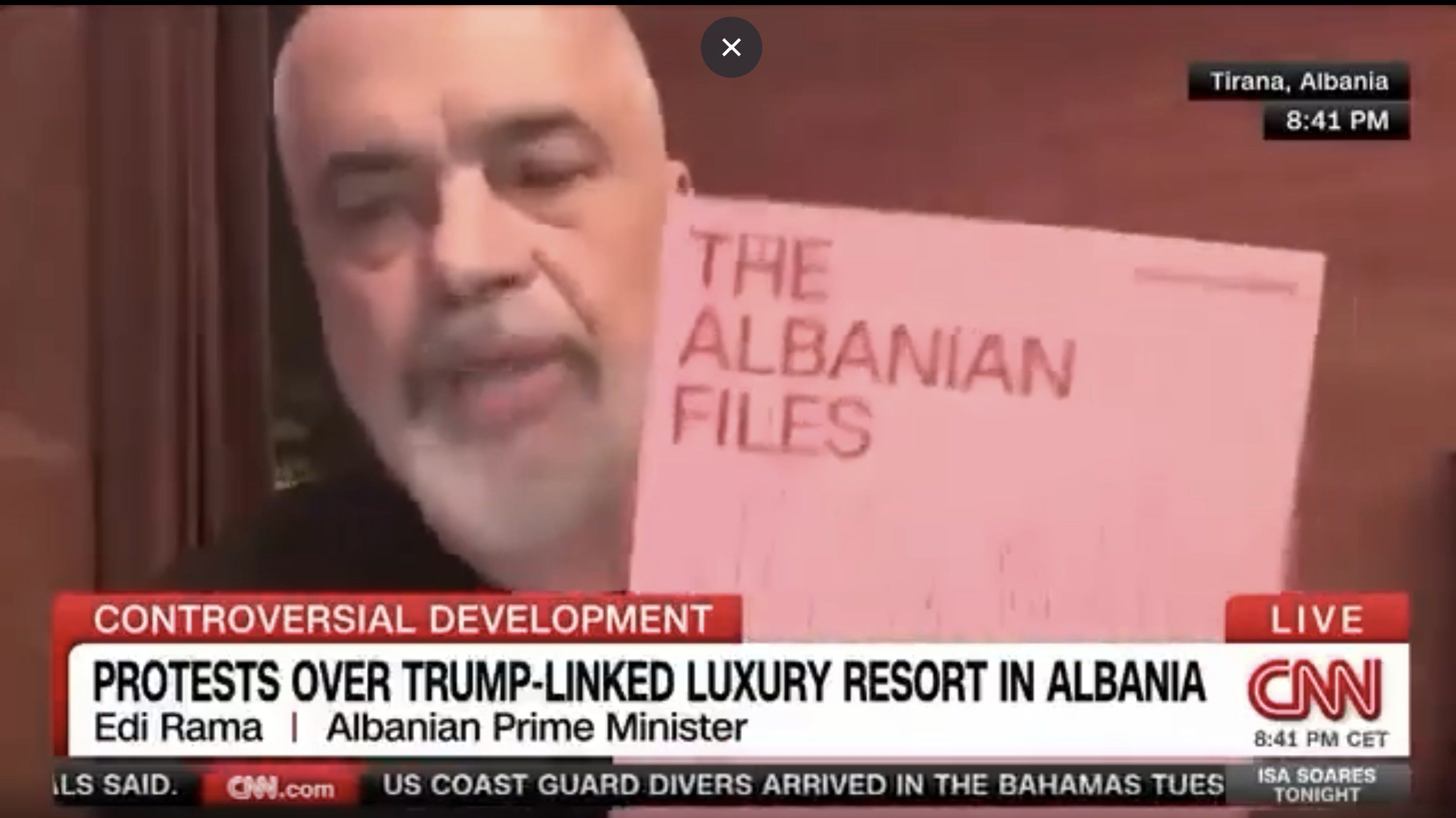
you can tell that it is getting to him.
The protests have not died down. What began in two coastal villages is now well into its second week in the capital, and the chants have changed. The crowds outside Rama’s office are no longer only asking him just to cancel the project. They are asking him to go. And this is not the opposition’s doing, the traditional parties have been sidelined, the demonstrators are jeering Rama and his old rivals alike, a whole political class rejected at once. They have a name for it now, the Flamingo Revolution. That is the kind of anger a government cannot simply wait out.
So he keeps explaining himself, appearance after appearance, insisting it is all a misunderstanding. At one point, in a Euronews interview, he said the quiet part aloud. Asked about the resort, he began to describe it as an elite enclave built on land that belongs to the Albanian people, then stopped and corrected himself: the land, he said, "belongs to the investors." They had bought it. For a man who built his entire career on controlling the image, it was a remarkable thing to say to a country marching under the slogan that Albania is not for sale.
The pressure has come from every direction at once. SPAK, the anti-corruption prosecutors, opened an investigation into how the land was reclassified and froze the accounts of one of the companies that bought up the Zvërnec beachfront. No wrongdoing has been proven, and the inquiry is an examination of process, not a verdict.
But notice how Rama has positioned himself. He backs the investigation, but only one half of it. Freezing money headed to the local sellers under suspicion is "welcome," he says, but blocking the transaction itself is "arbitrary and negative," because "the investors are within their rights." In other words: investigate the middlemen, protect the deal. He is not trying to stop the probe. He is trying to aim it, away from the project and toward the people who sold the land, so that some corruption can be exposed and the resort can still go ahead.
Let’s be real, though, a domestic watchdog in a country with Albania’s record is not what keeps a man like Rama up at night. What rattled him came from the one direction he could not dismiss. Not the protesters, whom he waved away as a hybrid war. Not the prosecutors he has outlasted before. But Brussels. On June 9th, the European Commission warned that the project could breach EU environmental law and put Albania’s accession, the thing Rama calls his life’s work, at risk, telling Tirana to “act without delay.”
That same day, the government that had sworn the investment would never stop announced it was suspending the project pending an environmental review. The man who said there was “absolutely no chance” it would halt while he was in charge had blinked. And what made him blink was not his own people in the street, not the bad viral PR, It was the club he is desperate to join, telling him this deal might keep him out.
The crazy and funny thing is that the bet Rama made, was almost working. The deal was moving exactly the way it was supposed to: quietly. Strategic-investor status granted, the protected map redrawn, the whole thing labeled "investment" and going through just as planned.
What blew it open was Ivanka Trump, going on a podcast to describe how she and Jared had “discovered” the island, swum ashore, hiked it barefoot, fallen in love with the view, narrating the acquisition of a protected Albanian island as a charming holiday anecdote. That tone-deaf little story is what turned a quiet local deal into a global scandal. The whole world looked, and what it saw flattered no one.
Rama knows it, too. "If it was not Jared, they would not give a shit about what is happening in Albania," he complained to Politico. He meant it as a grievance, that the world only cares because a Trump is involved. But it is also a confession. And the bitter part is that he is right: nobody outside Albania was ever going to care about another murky Albanian land deal. Corruption in Albania is a local story. Jared and Ivanka is a global one. By attaching the island and the coast to them, Rama borrowed the world's attention, and the same attention that was supposed to make the project shine is what dragged it into the light. The partner who was meant to make it dazzling is the reason nobody looked away.
So the great image-maker is left managing the worst image of his career. He once painted Tirana’s grey communist blocks in bright colors to change how the country looked. He cannot paint over this. And the cruelest part, for a man this careful, is who exposed him in the end. Not an enemy. His own partners, too rich and too far from the ground to understand that narrating the purchase of a country as a barefoot swim was the one thing guaranteed to make the world watch.